
Education has plenty of data. What it often lacks is memory.
A worksheet shows that an answer was wrong, but not always why. A message thread contains a teacher's suggestion, but it soon disappears under newer messages. A study plan records what was supposed to happen, while the reason it fell apart lives only in a parent's head.
Over time, a detailed learning process gets compressed into a few blunt conclusions:
"Math is inconsistent."
"They need to be more disciplined."
"Another careless mistake."
Those conclusions may contain some truth. They are still a poor substitute for context.
Hemiaoji is our attempt to keep that context intact: what was planned, what actually happened, what changed, and what should happen next.
Why we built Hemiaoji
Families and schools do not need one more disconnected education app.
There are already calendars, messaging groups, cloud drives, quiz tools, grade trackers, note apps, and AI chat windows. Each can solve a narrow problem. The difficulty begins when the work needs to move from one tool to another.
A task starts in a message. The completed worksheet lands in a photo library. A mistake stays on paper. A useful teacher observation is remembered for a week and then lost. When it is time to plan the next step, everyone reconstructs the story from fragments.
Parents become project coordinators. Teachers repeat the same organizing and explaining. Students receive a stream of instructions without seeing how one request connects to the last.
We started Hemiaoji around four practical gaps:
- records exist, but rarely form usable context;
- plans exist, but drift away from actual execution;
- feedback exists, but does not reliably shape the next action;
- AI can produce answers before it understands the learner or earns the right to make a judgment.
That led us to a different product definition: a collaborative memory system for learning. Its job is not to create another inbox. Its job is to connect tasks, coursework, knowledge, source files, and human feedback into a history that remains useful.
One workspace, not another disconnected app
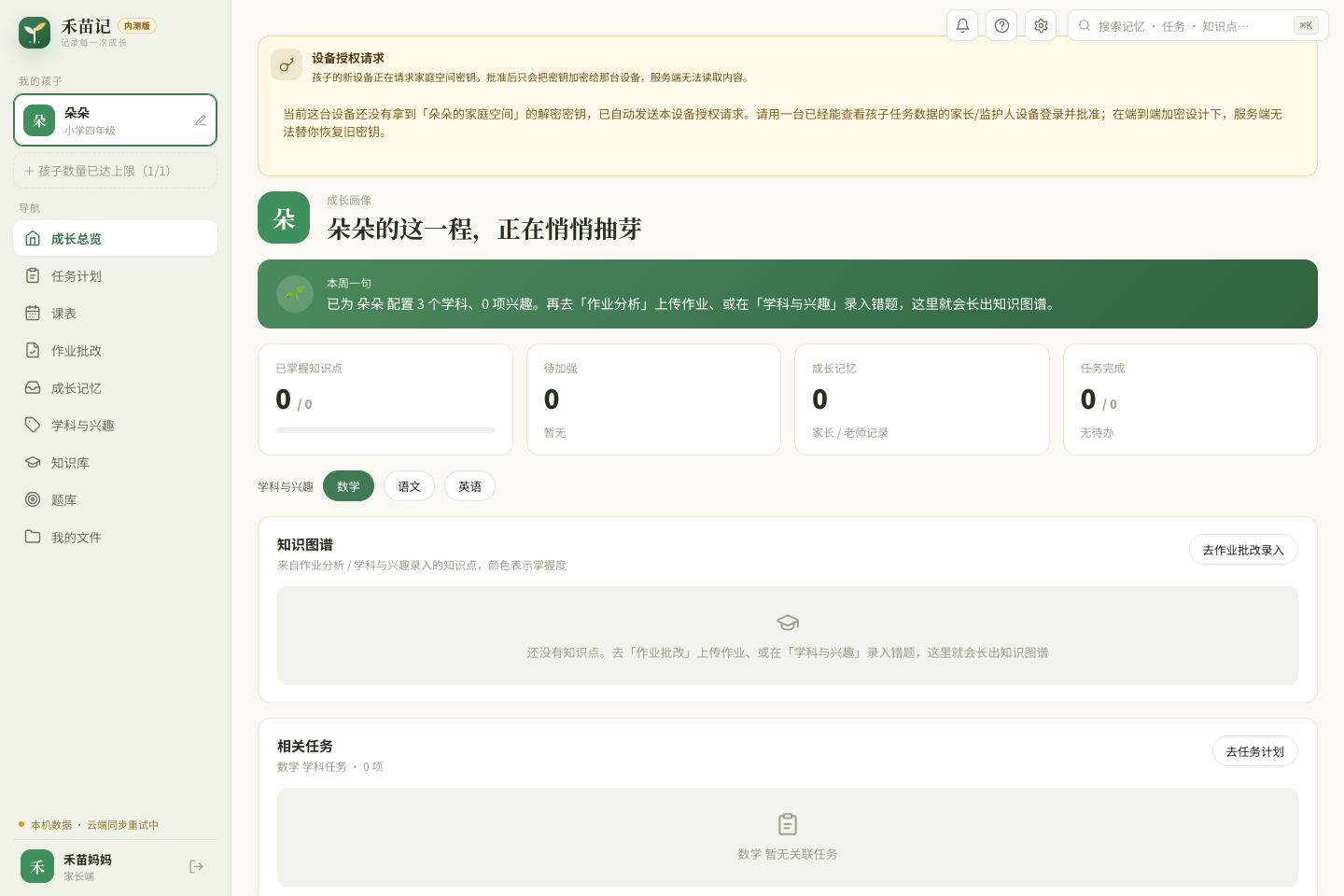
Hemiaoji is a local-first learning coordination app for parents, teachers, and students.
It is more than a reminder list, and it is not an AI chatbot with a school-themed prompt. Think of it as a learning map that becomes more useful as real work passes through it:
- tasks describe what needs to happen and what counts as a response;
- subjects and interests give related activity a stable home;
- assignments, questions, and concepts preserve the reason behind practice;
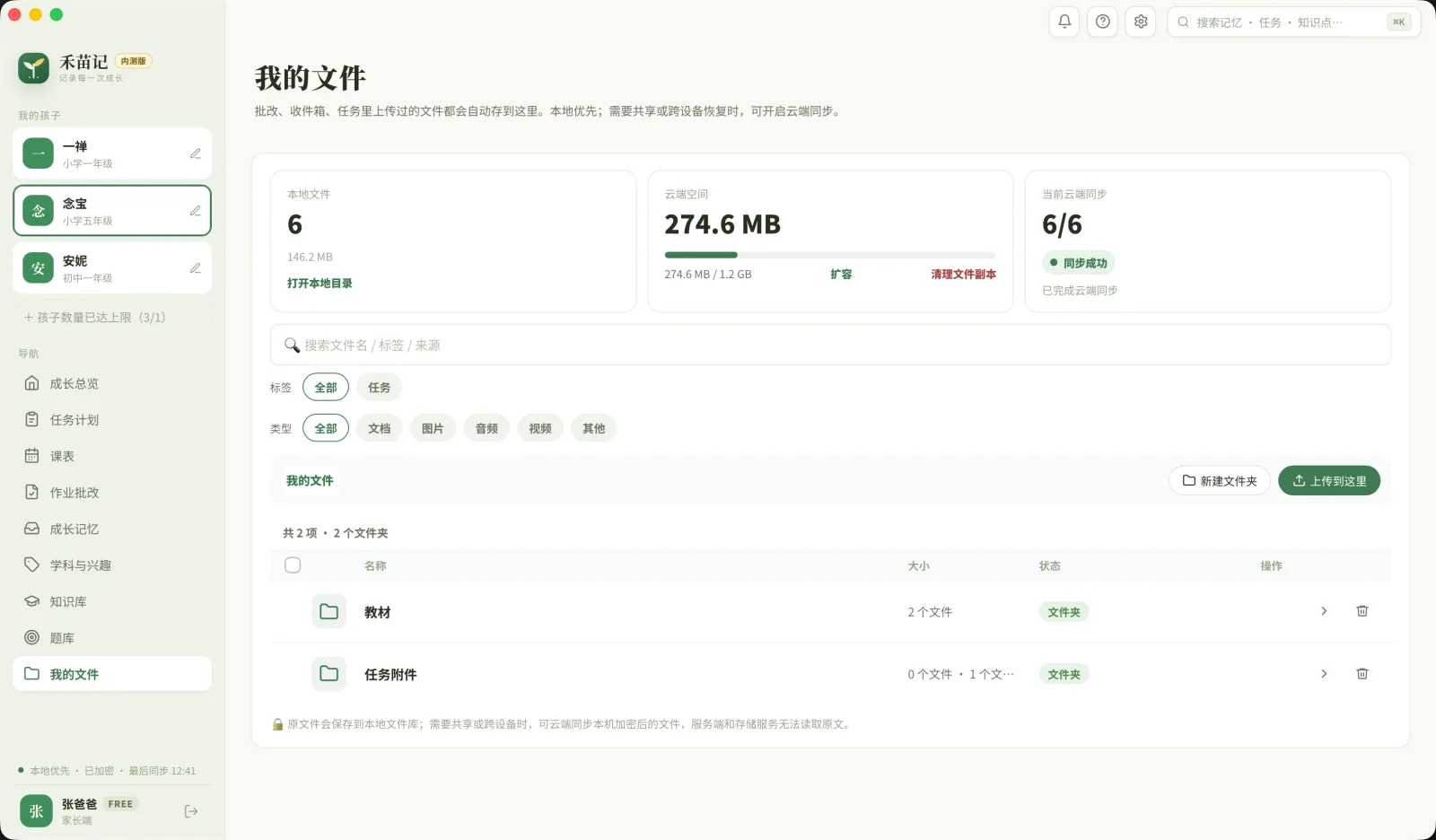
- files keep the original material alongside any summary or analysis;
- growth memories hold facts and changes that a person has reviewed.
Each role gets a different view and a different level of access. They are not maintaining three conflicting profiles. They are contributing to one shared context, with clear boundaries around who can see, propose, and confirm each part.
How the core workflow fits together
1. Task planning that survives contact with real life
"Work on math this week" sounds like a plan. It is not yet something a student can act on.
A Hemiaoji task can include a subject, start date, deadline, expected duration, priority, instructions, and a checklist. One-off homework uses a standard task. Reading, vocabulary, music practice, exercise, and other routines can run as daily, weekly, or monthly check-ins.
Completion is not reduced to a checkbox. A student can respond with text, photos, or files. A parent or teacher can review the response, add context, approve it, or send it back. The next plan can then react to evidence instead of mechanically moving unfinished work to another date.
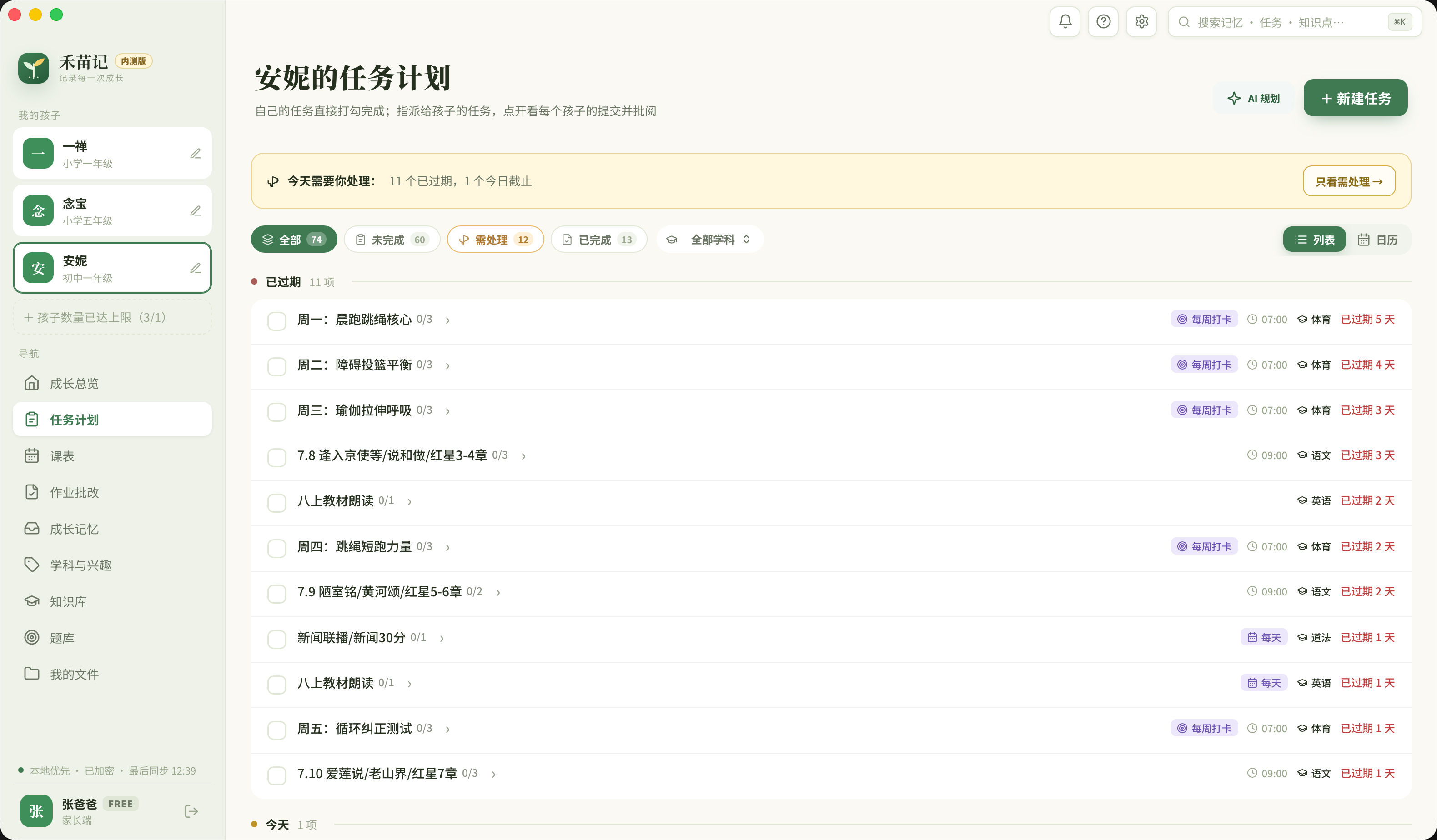
See how creation, execution, submission, and review form one continuous workflow.
2. Subjects and interests as living contexts
A child is not a spreadsheet organized only by exam subjects.
Math, language, and science can each bring together teachers, concepts, questions, tasks, and results. Drawing, football, dance, coding, or an instrument can have the same depth: classes, practice plans, materials, mentors, and moments of progress.
An interest should not be a line in a profile that goes stale. It deserves the same continuity and care as formal coursework.
3. From an assignment to a reusable learning signal
Homework analysis should do more than place a red mark beside an answer.
After an assignment is reviewed, the useful questions begin: Which concept was involved? Was the issue conceptual, procedural, or simply incomplete work? Is the question worth keeping for later practice? What kind of follow-up would test whether the learner now understands it?
Hemiaoji connects assignment analysis, the knowledge base, and the question bank. AI can help organize questions and suggest likely causes, but a person reviews the result before anything becomes part of the learner's record.

4. Source files remain part of the story
Even an excellent AI summary should not replace the material it summarizes.
Assignment photos, tests, lesson notes, task attachments, and learning resources live in a file system that preserves their connection to tasks, concepts, and memories. When someone revisits a conclusion months later, the original evidence is still available.
AI as a skill, not an authority
AI will change education software. That does not mean it should become an invisible decision-maker.
In a learning product, the dangerous failure is not only a wrong answer. It is a confident conclusion about a student made from partial context, then stored as if it were fact.
Hemiaoji therefore treats AI as a collection of bounded Skills, not one all-powerful assistant. A Skill requests only the information required for a specific job and returns a draft or proposal before it changes structured data.
The current beta is developing four workflows:
- AI task planning turns selected text, images, or files into an editable task proposal. Nothing enters the task system until the user confirms it.
- AI homework analysis identifies questions and responses, then suggests concepts, possible error patterns, and items for review.
- AI report-card extraction reads assessment names, dates, subjects, and scores from an image while keeping every field editable.
- AI concept lesson drafts generate an explanation, examples, and a short check for understanding that a parent or teacher can revise.
Model quality will improve. Our three product rules should not change with it:
- Minimum access: a planning Skill does not need the entire growth archive, and image access is enabled only when the user selects an image.
- Proposal before action: AI may organize, explain, and suggest. A human decides what becomes part of the record.
- Visible provenance: important outputs retain the Skill used, the data scope involved, and who approved the result.
Follow a schedule from source material through extraction, editing, and final confirmation.
Why local-first matters in education
A child's assignments, mistakes, routines, family conversations, and teacher observations are not ordinary engagement data.
Hemiaoji keeps local-first architecture at the foundation. Core data is stored on the user's device. Individual work can remain there. When a family needs collaboration or recovery across devices, encrypted synchronization is enabled for that purpose and with explicit authorization.
This creates extra work. New devices need approval. Encryption keys must be handled seriously. Cloud-based AI processing needs a clear explanation of what is being sent and why.
We believe that friction is justified.
Real ownership is not a sentence in a privacy policy. It is an architecture that makes it difficult for the service itself to bypass the user.
What comes next
Hemiaoji is still in beta. We would rather show a smaller number of working loops than publish a roadmap filled with feature names.
Our near-term work is focused on four directions.
Make the existing loops deeper
We are strengthening the two-way relationships among source files, assignment analysis, concepts, questions, and tasks. The goal is to complete a real workflow without losing context, not to add another icon to the home screen.
Make collaboration more deliberate
Teacher observations, AI analyses, and third-party outputs should begin as proposals. Clear permissions and review rules must decide who sees them, who confirms them, and when the student should be included.
Make Skills governable
We are building the runtime, model configuration, audit history, and review process needed for expandable AI capabilities. Every Skill should be able to state what it reads, what it does, and what it leaves behind.
Make local AI a practical option
Where device capability allows, parts of recognition, indexing, and inference should run locally while using the same proposal and confirmation flow as cloud jobs. Using AI should not require handing over an entire learning history by default.
We are deliberately building the foundation first. Smarter AI is useful only when the system around it is trustworthy.
The meaning behind Hemiaoji
The Chinese name is made of two ideas. He miao means a young seedling. Ji means to record or remember.
A seedling does not grow overnight because someone measures it more often. It cannot be rushed past rooting, branching, and the quiet stretches when progress is hard to see.
Learning works much the same way.
The point is not to turn every day into an efficiency contest. It is to lose less of the process, create fewer misunderstandings, and offer the right support when it can actually help.
That is why we call it Hemiaoji.
Not a system that defines a child's growth, but one that helps the people around them remember it with care.
Hello, Hemiaoji. Let us grow from here.
Public betaDownload HemiaojiThe clients are still evolving. Please read the beta notice and keep a separate backup of important material.